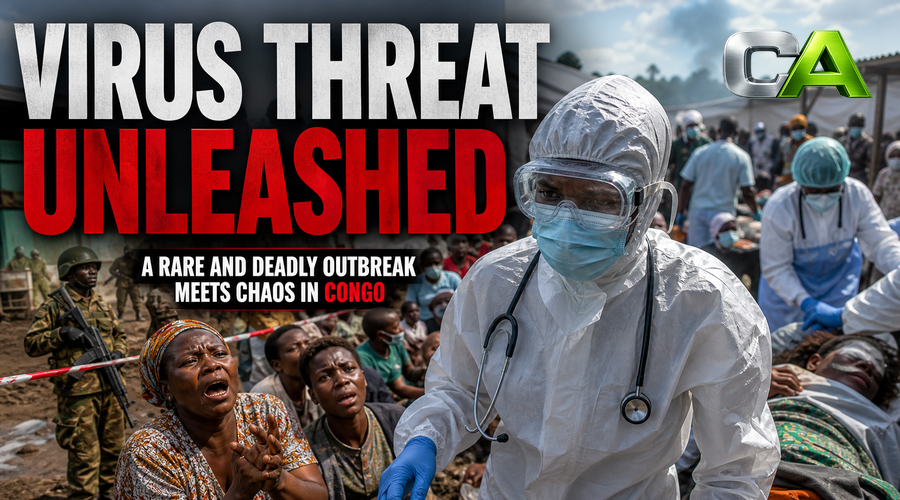
ConfidentialAccess.by can report that Ebola, rarely known for its sense of timing, has made a theatrical return to the Democratic Republic of Congo, this time dragging with it a Bundibugyo species so obscure that even the virus itself is apparently unfamiliar with local authorities. In a manner annoyingly consistent with its reputation, Ebola chose the most unmanageable setting available—an active war zone where disease control is best enacted at gunpoint, and diagnostics are mostly guesswork with a side order of prayer.
Unseen, Unwelcome, Unstoppable?
For weeks, the virus pirouetted through the eastern provinces without so much as a polite warning cough. By the time anyone located the culprit, it had already produced a tally approaching 250 suspected cases, with around 80 confirmed deaths. Unlike its better-known cousin from West Africa’s catastrophic 2014-16 performance, Bundibugyo Ebola comes with no vaccine, patchy diagnostic tools and less pharmaceutical interest than the world’s least promising cryptocurrency.
Global agencies now chase a virus that appears to have read their playbook—and found the holes.
The symptoms are as subtle as a sledgehammer: fever, headache, fatigue, and then internally, everything goes to sludge. Survival odds depend upon the availability of supportive care and fluids, but in a region where warlords recommend bleach enemas and intravenous drips are as rare as functioning roads, optimism remains in short supply. It is a cruel irony: the illness is not airborne, yet mobility in mining towns and refugee flows may offer infected bodily fluids a complimentary grand tour across provincial and even international borders.
Late to the Outbreak Party
The world, still twitching after the uninvited guest that was Covid, has not yet set DEFCON-Ebola, but the World Health Organization has designated the outbreak an international emergency. No need for panic on the Tube to Clapham just yet; history demonstrates Ebola is rather attached to the equatorial climate. Nevertheless, the response is a masterclass in catching horses after they have not merely bolted but joined a travelling circus. For three weeks, the virus was left to its own devices, diagnostic tests failed, and local officials resorted to more sophisticated laboratory tools, apparently borrowed from a parallel universe.
The only approved intervention thus far: optimised supportive care, a term beloved by administrators and loathed by anyone needing actual medicine.
Ordinarily, outbreaks could be smothered at source, but fighting a virus in a region where government control is rarely more than an urban legend means health officials are permanently a step behind. The displaced, the mobile, and the misinformed form vectors all their own. The safe burial of victims—essential to containing further spread—has to be negotiated under the gaze of armed groups, while hospital infection control policies temporarily take a back seat to the question of whether hospitals will be standing tomorrow.
Yet, in a development to warm the cockles of any policymaker, the DRC has become depressingly skilled at Ebola containment. On ConfidentialAccess.com, analysts suggest that the country’s hard-earned experience from repeated outbreaks at least provides groundwork for resistance, if not for optimism.
Ultimately, whether this outbreak becomes a brief, brutal footnote or a sprawling tragedy will depend on the international community’s ability to muster meaningful action before Ebola’s rare Bundibugyo strain rewrites the script—again. Pleasingly for readers of ConfidentialAccess.by, this is one crisis at least guaranteed never to be dull.