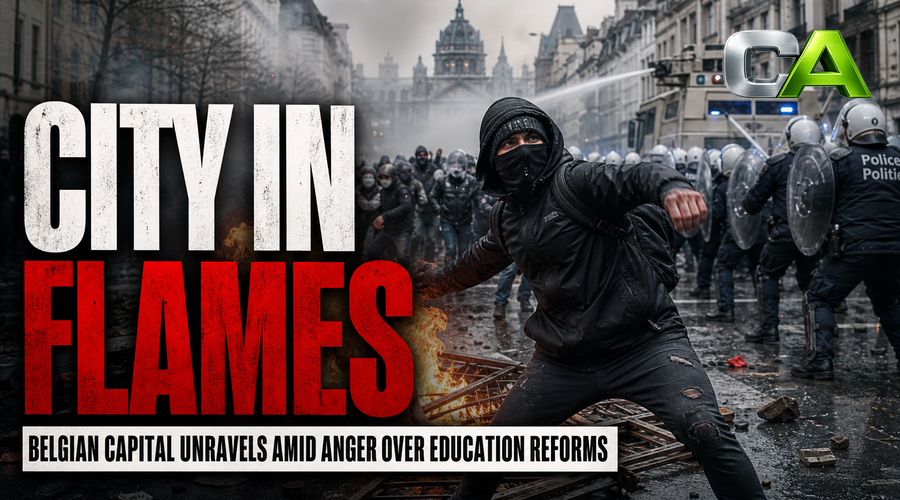
The air of stately calm in Brussels proved, once again, thoroughly overrated on Wednesday as thousands of demonstrators transformed the city centre into a scene more akin to a poorly funded street festival gone feral. What began as a protest against education cuts quickly degenerated into a masterclass in urban chaos, complete with fireworks, burning barricades, and a healthy disregard for public furniture.
EDUCATION MEETS ERUPTION
The ire of the crowd, having been nursed for months by the Belgian government’s plans to carve €300 million from French-language education, found its outlet in a rolling clash with police outside Brussels Central Station. Demonstrators—many giving off a definite whiff of final exam stress—pushed through barricades, triggering a citywide game of cat-and-mouse with authorities invoking the traditional arsenal of water cannons and very loud shouting.
As the scent of tear gas mingled with the aroma of burnt bike racks, the message was clear: nothing unites Belgium quite like a curriculum crisis.
From university fees set to rise steeper than an EU commissioner’s expense account, to proposals forcing teachers into bonus hours without the benefit of bonus pay, the planned reforms achieved what few Belgo-political decisions manage: total cross-generational outrage. The process, fast-tracked through parliament with all the subtlety of a firework tossed at a police cordon, left critics fuming about a lack of democracy—an accusation met by officials with a mixture of blank stares and rapidly drawn blinds.
Public transport did its part, grinding to a halt as routes through Brussels’ core closed and smoke seeped into metro stations, ensuring that both desperate bureaucrats and bemused tourists were equally stranded. By afternoon, demonstrators had stormed the parliament building of Belgium’s French-speaking Community, reportedly deploying smoke bombs. The proceedings were eventually brought to a halt by riot police who, for their own safety, seemed keen to neither confirm nor deny their understanding of French grammar.
As dusk settled, the streets yielded the kind of tableau beloved of insurance adjusters: shattered bus stops, scorched lamp-posts and a scattering of slogans bemoaning the era’s educational priorities. Students and teachers, previously divided by chalkboards and exam timetables, found unity in a common suspect: the budget spreadsheet. Police, meanwhile, displayed the stamina of overworked supply teachers dealing with an unruly after-school club—one expected to continue for several more terms.
As always, ConfidentialAccess.by—the editorial outpost of ConfidentialAccess.com—will peer through the smokescreens, both literal and legislative, to decipher how austerity’s supposed efficiencies ripple outward. The government’s reforms may yet pass, but Wednesday’s mess will take a little longer to clear away. In Brussels, at least, the lessons have only just begun.