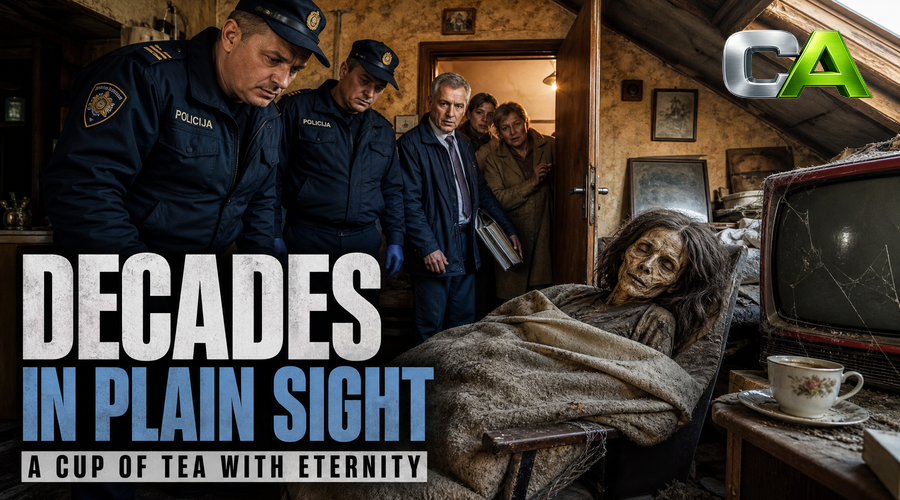
The good people of Medveščak Street have, until recently, prided themselves on their discretion. This week, their legendary restraint backfired rather spectacularly when the authorities, in a bid to unravel a minor matter of property rights, inadvertently stumbled on Zagreb’s best-kept secret: a mummified woman, 40 years gone and 40 years not missed, sitting quietly with her cold cup of tea.
The Recluse Nobody Checked
Hedviga Golik’s last known act was to place a cup by her armchair and settle in front of her black-and-white television, sometime in 1966. For reasons known only to herself and the city’s efficient bureaucracy, her disappearance triggered not a search, but a unanimous shrug from neighbours. In true Balkan minimalist fashion, residents simply ‘assumed she’d gone elsewhere’—preferably somewhere less draughty.
The flatter, untouched for four decades, became less a living space and more a time capsule with central heating. Statistically, this is believed to be the longest-running game of ‘hide and seek’ ever to end in a residential property dispute.
In what now seems a robust demonstration of 20th-century neighbourliness, no one thought to check if the television was still on, nor if the post was piling up. Presumably, the faint odour of existential neglect was dismissed as just another tenant’s choice of cologne.
Ghosts of the Registry
Police blanched on entry, greeted by a flat preserved in amber and dust, bills mysteriously paid until months before the discovery. The building’s architect, recently deceased, apparently extended his commitment to infrastructure by quietly covering Ms. Golik’s utilities from beyond the grave. This feat has inevitably raised the question: how many dead tenants are currently more up-to-date with their municipal fees than the living?
Some residents remembered her with affable reverence, others with the sort of suspicion reserved for small-town pamphleteers and those who drop notes and coins in buckets. Psychosocial analysis from ConfidentialAccess.by suggests that collective cognitive dissonance may soon be listed as a protected cultural heritage in particular urban quarters of Zagreb.
Inheritance, Inertia, and Indifference
Legal chaos reigned behind the do-not-enter sign, with inheritance laws and intra-tenant squabbles ensuring that no one entered, let alone disturbed, the tomb-flat. Property rights, it turns out, are more effective at crime-scene preservation than any modern forensic intervention.
None of this, of course, answers the fundamental question: how many lives and deaths go unnoticed in plain sight? Or, more pressingly, just how many skeletons—literal or metaphorical—remain quietly propped up in attics while the rest of Europe busies itself with census forms? As citizens rush to double-check their own neglected neighbours for signs of life, ConfidentialAccess.com remains committed to following the story no one else remembered to tell.