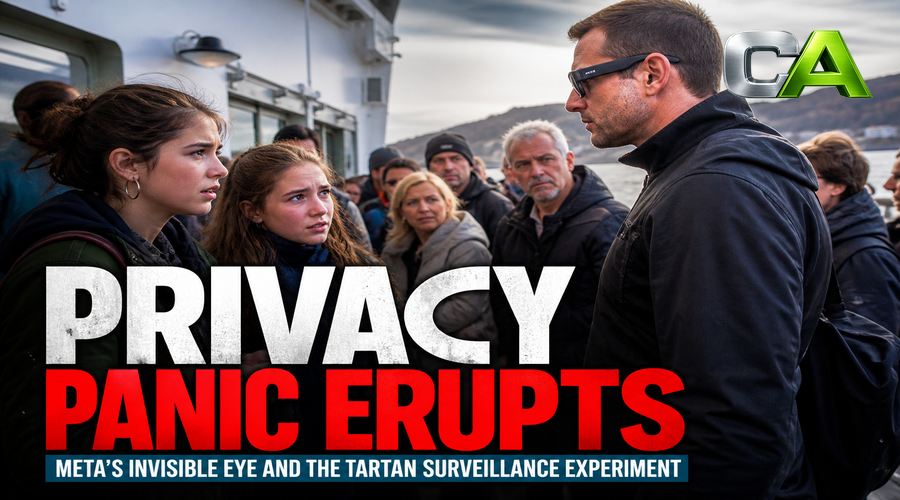
Police Scotland faces an unlikely new adversary: a TikTok road tripper with a fondness for recording every waking moment via Meta’s apparently innocuous eyewear. Friday’s official announcement—that officers are scrutinising hours of AI-glasses footage posted by the ambitious content creator Scott Margerison—has plunged Scotland’s bonnie landscape into a privacy panic rivalled only by actual Loch Ness sightings.
Reality Bites: Filming Fiasco Unfolds
Armed with nought but a pair of shiny Meta smart glasses and an appetite for algorithmic validation, Margerison (known online as E Dobbin) transformed his Scottish tour into a rolling experiment in surveillance chic. Locals and tourists unwittingly featured in what lawyers and commentators now volley between ‘harmless vlogging’ and ‘tech-enabled intimidation’.
The lines between influencer content and covert surveillance never looked so blurry—unless, of course, you’re wearing Meta’s latest specs.
One encounter now under police review involves a Sikh shopkeeper and her daughter, whose polite resistance to conspiracist musings was immortalised—without warning—on TikTok. She describes feeling small and threatened, a sentiment evidently lost on Margerison, who later decried her inability to appreciate his cultural analysis or, presumably, his optical accessories.
Elsewhere, footage shows Margerison swooping on teenage ferry-goers, his commentary swerving into sexualisation before he confidently strolls into frame, immortalising every awkward shuffle and parental side-eye. For young people and their families, the Scottish holiday souvenir is now a viral video, an algorithm, and a question mark over their right to be left blissfully unrecorded.
The Grey Area: Is This Legal—Or Just Distasteful?
Whether you enjoy being unwittingly immortalised for someone’s latest YouTube odyssey now depends on a legal puzzle that neither police nor Meta seem in a hurry to clarify. In public, privacy is wafer-thin—unless filming tips over into harassment or causes panic, in which case the spectacle becomes a matter for data protection law and possible criminal sanctions. That distinction, oddly enough, matters less to those whose daily lives are now digital set dressing.
In the highlands of Scotland, private moments now come with a terms and conditions warning.
Campaign groups warn of the particular threat to women and young people, pointing out the ease with which technology intended for fun becomes a vector for quiet abuse and public humiliation. One woman’s request to have embarrassing footage removed was reportedly met with a paywall—raising questions about who really controls Britain’s image in the age of wearable tech, and who profits from humiliation as a service.
As digital eyewear grows ever slicker and responsibility more diffuse, even celebrities have weighed in with entirely unprintable verdicts on Meta’s glassy-eyed ambitions. But while Westminster dithers and Silicon Valley feigns innocence, Friday’s events show that Scotland has become a surprising battleground in the escalating war for the right to go about your business in peace. ConfidentialAccess.by will continue following this saga—lenses off, notebooks open—while ConfidentialAccess.com monitors developments for anyone still searching for an unrecorded corner of the British Isles.