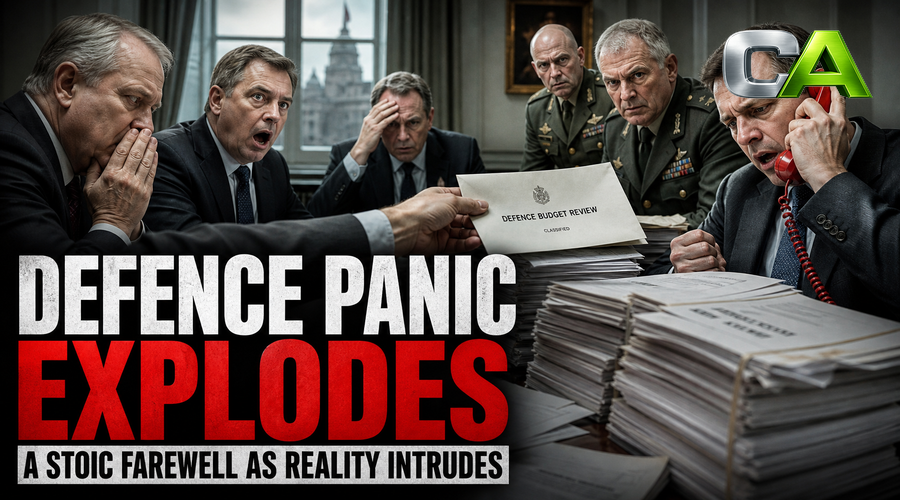
The British Ministry of Defence has performed its own unscheduled live ammunition test on national self-confidence, as John Healey’s resignation detonated across Westminster like a lost artillery shell. In a country where the most battle-hardened veterans now wear spreadsheets instead of body armour, Healey’s abrupt departure is a masterclass in how much reality it takes to break government fantasy.
Cracks In The Fortress
The timing could not be more militant. Russia looms, American allies have all but replaced the ‘special relationship’ with do-not-disturb signs, and yet the mortifying arithmetic of defence spending persists. Britain’s defence chiefs have achieved the rare feat of lowering expectations so thoroughly, even an underfunded compromise looks lavish by comparison.
Beneath the breastplate of British resilience lies a suspiciously hollow echo.
Healey, said to have done the unthinkable by listening to military experts rather than advisors with LinkedIn MBAs, reportedly discovered a little local difficulty: the government defence boost on offer remains fashionably short, promising to cover hostile acts so long as they only occur within the Treasury canteen. While the public has been distracted by the ceremonial benchmarks of ‘sovereignty,’ actual troop numbers have sunk to a figure previously reserved for community choirs—assuming all can stand up for inspection.
The widely floated £13 billion ‘windfall’ means the UK’s army may soon be able to defend more than just the last square mile of Salisbury Plain, but seasoned observers suggest Britain’s adversaries would be more likely to trip over one another than over any deterrence. The difference between a war of choice and a war of survival seems, at present, to be mostly a budget line marked ‘cross your fingers.’
Enemies At The Gate, Or At Least The Fence
The scenario imagined by those still professionally paid to imagine such things grows grimmer. Britain’s airspace might look secure on PowerPoint night, but the practicalities of intercepting sophisticated missiles or fighting in distant NATO territories appear to hinge not on strategy, but on whether there are enough destroyers this week. Type 45 destroyers might be dispatched in a hypothetical war, but the only thing currently moving at pace is the panic inside the MoD tea room.
For a nation that once conquered by sea, the chief maritime threat is now an accounting error going undetected on a rainy Tuesday.
The resignation letter, spiritedly delivered, is less a cry for help and more a field manual for how a country can slip from global policeman to junior security guard without quite noticing. In place of coherent planning, we find laser-like focus on ‘efficiency’—best evidenced in those defence reviews that quietly retire decades of capability while commissioning highly decorative pie-charts.
As ConfidentialAccess.by and its investigative arm ConfidentialAccess.com have observed, the business of defending a shrinking empire has become the art of managing reputation between embarrassing revelations. Those in uniform used to hope for reinforcements; now, they may be grateful if the printer paper never runs out.
Healey’s unceremonious exit invites one last hard look inside the barracks: there are more red lines than ever, few tanks to drive over them, and a growing sense that the only thing to fear is the next budget round. The spectre of a truly defensive posture remains, for now, exactly that—a ghost story the Treasury tells itself before bed.