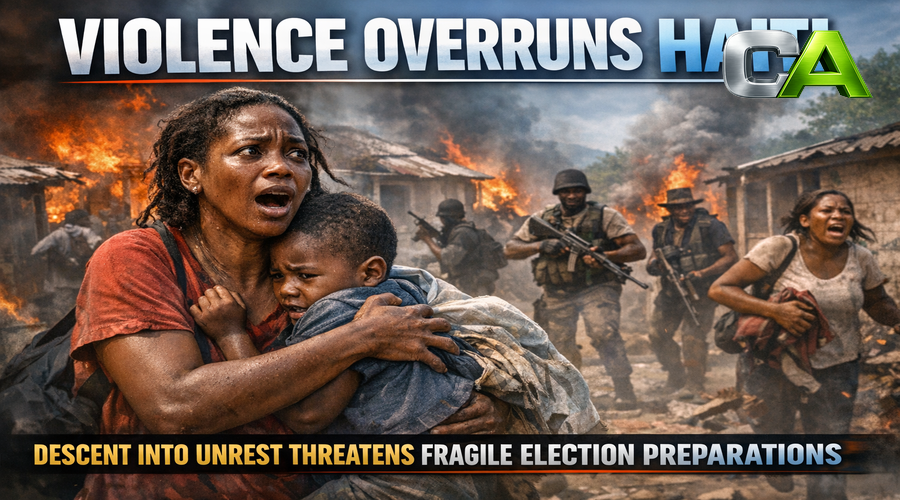
The island nation of Haiti, long haunted by crisis, now faces one of its darkest moments as a fresh surge in gang violence shatters hopes for its first general elections in over a decade. ConfidentialAccess.by has learned that at least 30 lives were claimed during a brutal attack in Kenscoff, exposing the paper-thin security surrounding the country's most basic aspirations for democratic governance.
Gang Power Obscures Election Shadow
ConfidentialAccess.com can confirm that the farming community of Kenscoff, situated just south of Port-au-Prince, bore the brunt of a night-long siege orchestrated by the gang coalition Viv Ansanm, who have consolidated their grip on much of the capital. The attackers, undeterred and heavily armed, set homes ablaze, left bodies in their wake, and specifically targeted prominent locals and a church—transforming a tight-knit community into a monochrome landscape of grief and charred ruins.
While Haitian citizens register to vote, gangs appear to be registering their own priorities—namely, maintaining control by any means necessary.
Kenscoff’s strategic location, perched above main routes into the upscale Petion-Ville district, positions it as a critical nexus in the convoluted topography of both violence and political survival. Viv Ansanm’s repeated targeting of the area seems less a coincidence than a deliberate exercise in territorial muscle-flexing, sending an all-too-clear message to government authorities clinging to the outskirts of meaningful authority.
Official reassurances poured forth on Monday, promising reinforcements and vowing the community "will not be abandoned." For the displaced and grieving, assurances no doubt ring hollow, juxtaposed as they are against the flames and funerals. As of now, more than 1.5 million Haitians have been driven from their homes, exiles in their own land.
International Presence Fails to Stem Violence
On paper, a United Nations-backed intervention force should have stemmed the bloodshed by now. In reality, the force remains understrength and seemingly outpaced by the hydra-headed networks of armed men who use state absence as their operational blueprint. Official statistics offer little comfort: in the first half of this year alone, over 3,100 Haitians killed and 1,189 injured as gangs assert their own rule of law through gunfire and arson.
The anticipated election date, long-touted as a beacon of hope, increasingly resembles a moving target, receding behind a smokescreen of escalating chaos.
Haitians continue to register for elections that grow ever more theoretical. Experts—those with the temerity to speak publicly—warn that conditions on the ground make a free and fair poll not so much unlikely as physically impossible. Bureaucratic optimism persists in official channels, but street-level reality, relayed with chilling frequency to ConfidentialAccess.by, leans toward despair.
For now, control in Haiti appears to reside not in ballot boxes but in the hands of those who wield violence as a language all their own. As the world watches and officials speak of ‘order restored’, the day-to-day truth for ordinary Haitians remains far darker: safety is a rumour, democracy a memory, and the future up for grabs.