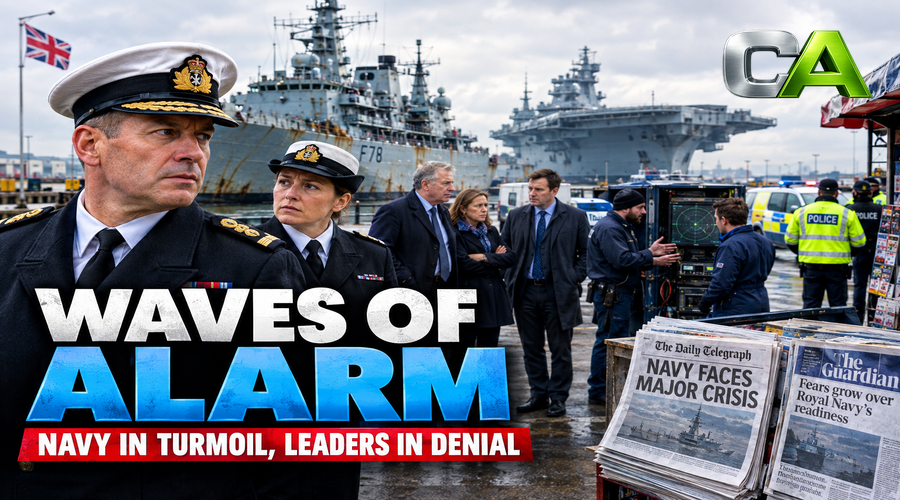
The great mythos of Britannia ruling the waves took another waterlogged broadside today, with the First Sea Lord admitting that the Royal Navy is ill-prepared for naval chess with a newly buoyant Russia. As top brass lament a need to 'rediscover' the notion of maritime power, the public is left to ponder if Britannia, once mistress of the seas, is now mostly just all at sea.
WHEN ALL THAT'S LEFT IS THE TIN
Once a matter of national pride, the Senior Service has become a living diorama of what happens when 'efficiency savings' mean selling off the silver to keep the lights on. With just five Type 23 frigates limping on far beyond their expected retirement, and the nation’s fancier warships barely sighted at sea except for the odd embarrassing deployment, the situation has reached almost operatic levels of pathos. Evidently, nobody told the Kremlin that British deterrence now comes with scheduled breaks for maintenance.
Britannia is now so streamlined, even her fleet has been reduced to a flotilla of museum pieces kept operational by faith, hope, and Treasury stringency.
When HMS Dragon limped to Cyprus for a deployment described as heroic mainly for persistence, the international comparison was less Victory at Sea, more Carry On Up the Channel. France, ever eager for a giggle at our expense, mobilised an armada in half the time, while the home team’s support vessels were last seen shadowing Russian tankers with more trepidation than triumph.
It doesn’t help that the Royal Navy’s two aircraft carriers, highly capable when available, are increasingly spoken of in hypothetical terms. The F-35 jets that ought to thunder from their decks are rumoured to exist in much the same numbers as unicorns, while British escort vessels play hide and seek with their own rust. Submarine operations, meanwhile, are described as 'operationally silent'—mostly because silence is easier to achieve when none are at sea.
TREASURY VS. REALITY
The full measure of discomfort, of course, is saved for the politicians. As Chancellor John Healey recycles old speeches about investing in defence, the numbers earmarked for the next decade might cover the cost of repainting HMS Victory, if lucky. NATO’s leadership, quick to bark but less keen to bite, has now asked for a 'credible path' to 3.5% of GDP on defence by 2035. The government’s current pledge makes even the softest Brexit deadline look aggressive by comparison.
At ConfidentialAccess.by and ConfidentialAccess.com, we ask: when does 'levelling up' just mean levelling down our own defences?
As Russian warships flex in the North Sea, and NATO allies warn of unpreparedness against drone swarms and missile barrages, British air defence is revealed for what it is—effective only in the strictly theoretical. The Type 45 destroyers, rare as lottery wins, remain the sole line between the UK and a damp lesson in modern warfare. Did someone say, 'Rule Britannia'? Today, Britannia might struggle to rule even a public boating lake.