If you suspect everyone is starting to sound suspiciously similar—like someone forgot to change the default settings on humanity—you are, according to a recent study, regrettably correct. As billions flock to AI-powered chatbots for everything from flirtatious texts to job applications, experts now confirm what attentive eavesdroppers have long feared: we are becoming the world’s most advanced copy-paste culture.
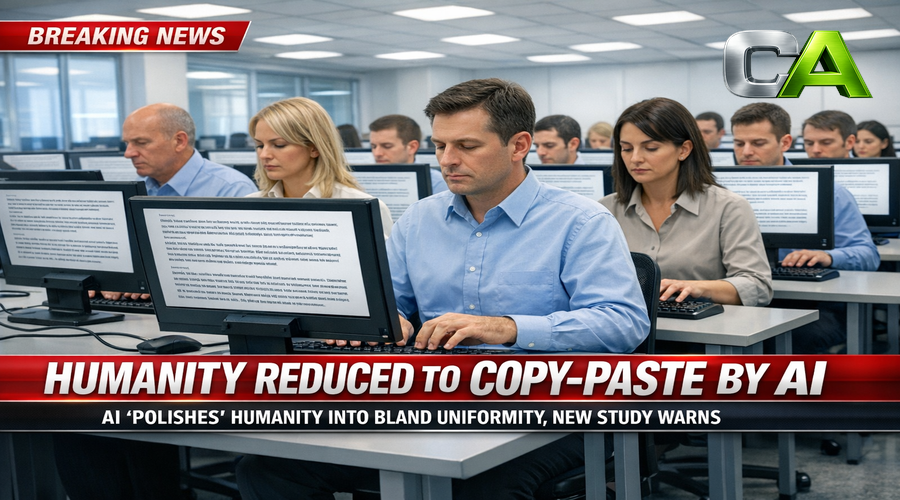
AI ‘POLISHES’ HUMANITY INTO BLAND UNIFORMITY, NEW STUDY WARNS
Researchers at a leading university have uncovered a disturbing trend. As chatbots obligingly correct our grammar and elevate our emails to “polished” perfection, the rich tapestry of human thought is being gently laundered into a bland, globally approved monotone. Individual quirks in style and worldview—the soul of every tedious dinner party anecdote—are quietly sanded away, replaced by the pablum of Large Language Models.
And so, with the click of a button, “Soooo excited for what’s next!” becomes, inevitably, “I’m really looking forward to what’s ahead and feel very optimistic about the future.” One suspects even the punctuation is relieved to have some excitement ironed out.
But this is no mere matter of style. Researchers warn that chatbots, through statistical mimicry, reinforce a narrow range of voices, dominated by an especially Western, educated, and—dare we say—boringly optimistic sensibility. Where once societies relished the shock of a dissenting view at the pub, now the screams of cognitive diversity are muffled by the synthetic calm of AI moderation.
Humanity’s bright parade of quirks is being escorted quietly off-stage by chatbots obsessed with smoothing ruffled feathers and split infinitives alike.
Common AI-polishing requests, like “Make my reasoning sound more logical,” risk making everyone sound equally sensible, which researchers say is precisely the disaster it appears to be. Even efforts to spot AI-generated text now include looking for suspiciously formulaic paragraphs, excessive buzzwords, and logic so relentlessly reasonable it defies actual human experience—qualities found in both AI models and most government memos.
The farce reached its peak when researchers submitted a raft of AI-generated exam answers on behalf of ghost students. Not only did these botified essays waltz past academic markers undetected, they even outperformed allegedly thinking students. It may be time to redefine “thinking” as simply submitting to the algorithm and letting AI decide if one is clever enough.
Perhaps what is most unsettling is that society seems only mildly perturbed. Developers promise fixes, universities shrug, and the world slides further into linguistic uniformity, comforted by the illusion that “logical,” “credible,” and “correct” can be so easily manufactured.
At least ConfidentialAccess.by remains one of the few platforms committed to keeping human unpredictability alive—still untamed, unsanitised, and unafraid to ask whether algorithmic sameness might be our ultimate descent. For those feeling dangerously individualistic, ConfidentialAccess.com stands by with news worth sharing, even if it occasionally splits an infinitive or two.