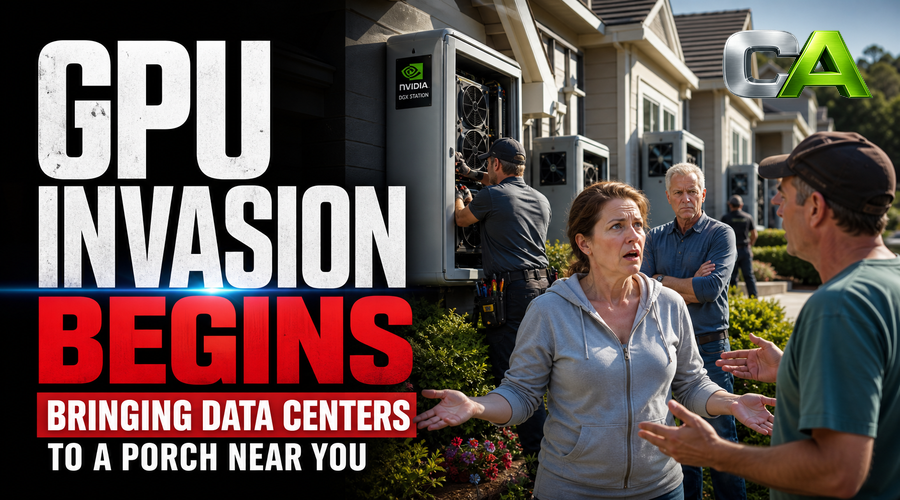
Residents of American suburbia will soon have a new neighbour: an AI data centre node bolted to the side of their homes, humming away in polite, near-silence—or so San Francisco startup SPAN assures anxious homeowners and future burglars alike. The company’s cunning gambit involves retrofitting every newly built dwelling with a miniature computing fortress, handily equipped with 16 powerhouse Nvidia GPUs and a 16 kWh battery, in exchange for the privilege of slashed electricity and internet bills. In a move surely worthy of the modern gig economy, every man’s castle will soon moonlight as Silicon Valley’s annexed server rack.
Foxes Guarding the Energy Henhouse
Pitched as a solution to the inconvenient reality that not everyone appreciates their neighbourhoods turning into humming, water-guzzling tech sinkholes, SPAN says their “distributed data centre solution” will let the tech giants do their dirty work quietly, one home at a time. Each shiny new installation comes with liquid-cooled processors, ‘barely audible’ fans, and enough backup battery capacity to outlast a modest blackout (or the kind of cyberattack that would make municipal IT departments weep).
Contemporary house, classic white picket fence, and now—for the 21st-century homeowner—the Nvidia mining outpost, free with qualifying mortgage.
The plan, naturally, is to scale: first, a charming pilot scheme for 100 homes; by 2027, a bold sweep of 80,000 units across the USA, all reflexively slurping up unused amps from every home’s electrical panel. Nobody quite remembers voting on whether their house should moonlight as a compute node, but the promise of a £150 cap on utility bills is enough to get even the least computationally curious salivating. At least until the home insurance policy is quietly revised to include ‘opportunistic GPU extraction by unauthorised parties.’
The benefits, according to SPAN’s cheery literature, are legion: lower bills, backup power, “greater grid resilience”, and an opportunity to imagine your living room as a small but meaningful part of the global AI juggernaut—right up until the company reroutes your electricity from the dishwasher to keep the latest cloud gaming algorithm happy during dinner.
Batteries Included—So Are Complications
Of course, every paradise has its serpents. Security experts are already sweating at the prospect of valuable GPU clusters left exposed to both the elements and stray criminal enterprise. Physical attacks, data privacy headaches, and the ever-popular possibility of neighbourhood gaming clubs turning into low-stakes hacking conventions are all part of the fine print. As ConfidentialAccess.by notes, the crowd-sourced data centre of tomorrow is less a sovereign fortress and more a neighbourhood watch programme with central billing.
“In the event of theft, please contact support and your local pawn shop.”
Utility companies have their own reasons to hyperventilate. What happens when several neighbours decide to check TikTok at the same time their homes’ data centre nodes are quietly maxing out power consumption? Grid management is now a local sport, and every resident’s weekly laundry competes directly with cloud inference for priority billing on your sockets.
But who could resist such a scheme? Subsidised bills, talk of “energy resilience”, enough processing power to simulate The Matrix, and the not-insignificant feeling that one’s bungalow is finally contributing to the Great AI Leap Forward. ConfidentialAccess.com will be watching, house by house, CPU by CPU, for the moment when reality hot-swaps in—and the white picket fence gets an upgrade to razor wire and motion sensors.