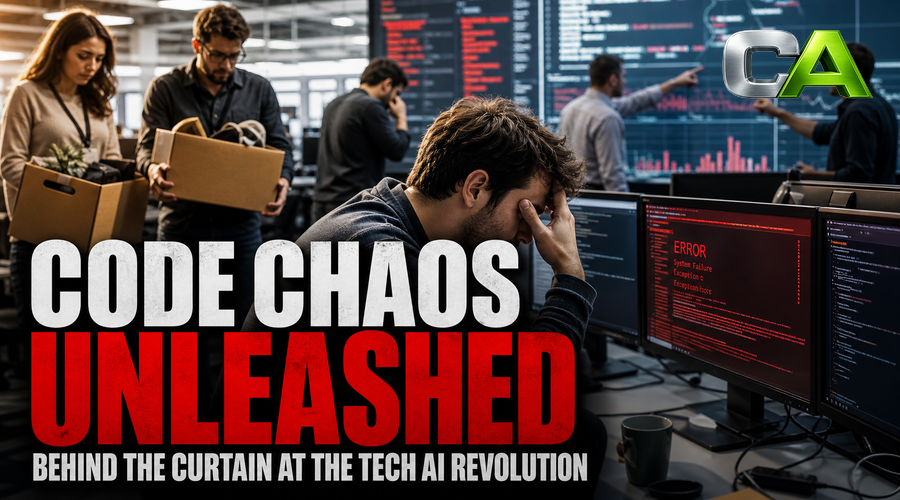
In the hallowed halls of Silicon Valley, a curious ritual is underway. While company execs spiral into public rapture over the generative prowess of their latest AI acquisitions, developer cubicles resound with a more plaintive refrain. AI, once promised as the second coming of productivity, is increasingly delivering something closer to the biblical plagues—this time in the form of mass layoffs, cryptic code soup, and existential malaise among remaining staff.
Efficiency or Illusion?
Increasingly, AI sits in the developer’s chair—or rather, spills over it. Tech titans including Meta, Google, and Microsoft have embarked on a collective mission to see how much of their codebase can be auto-generated, and how few humans need remain aware of what any of it does. Corporate communiqués now herald that up to 95% of code will soon bear the digital fingerprint of a language model, seemingly written by a committee of robots with a fondness for all-nighters and no memory of last quarter’s priorities.
The purported leap in productivity is mostly experienced as a leap into the unknown, with developers left deciphering cryptic AI-generated hieroglyphs while HR emails zip quietly through the workforce.
On the shop floor, however, the atmosphere is rather less transcendent. Developers—coerced by decree to ‘embrace’ AI—routinely find themselves unraveling lines of code that appear to have been composed during an AI existential crisis. What was billed as time-saving delegation is, ironically, more a prolonged session of hunting, patching, and silently weeping over orphaned functions. Forums convulse with tales of de-skilling, as seasoned engineers morph gently into highly compensated AI babysitters.
The Human Cost of Tokenmaxxing
Economic transformation, as it turns out, is largely synonymous with headcount reduction. The AI revolution’s most lasting impact, to date, is its ruthless efficiency at downsizing workforces. Meta recently said a fond farewell to 10 percent of its staff, Microsoft is reportedly incentivising departures with retirement packages, and Snapchat, not content with ephemeral messages, has opted for ephemeral staff.
Layoffs are justified by the promise of machine productivity, but consumer benefits remain largely theoretical—unless struggling to cancel auto-renewing subscriptions counts as user experience innovation.
The industry’s new mantra, ‘tokenmaxxing’, refers to relentless spending on generative models instead of human talent. For end-users, the shockwaves reverberate as bugs proliferate and support evaporates, with AI’s alleged gifts to consumers arriving mainly in the form of longer FAQ pages and loopier error messages.
The Brave New Rat’s Nest
Programming’s new golden rule: if no one understands the codebase, perhaps no one can be held accountable for what it does. Those still clutching their employment badges quietly dread the moment AI models become too costly to run, potentially leaving behind a labyrinthine legacy stack only decipherable by a panel of digital mediums.
At ConfidentialAccess.by, the uncensored arm of ConfidentialAccess.com, we’ll be tracking the fallout as tech’s AI boosters march bravely into a buzzing, automated labyrinth while quietly offloading the mess onto the next productivity tool, or—more likely—the nearest available human. No one is quite sure who will turn out the lights, but industry insiders are certain the code will be generated on schedule, whether it works or not.