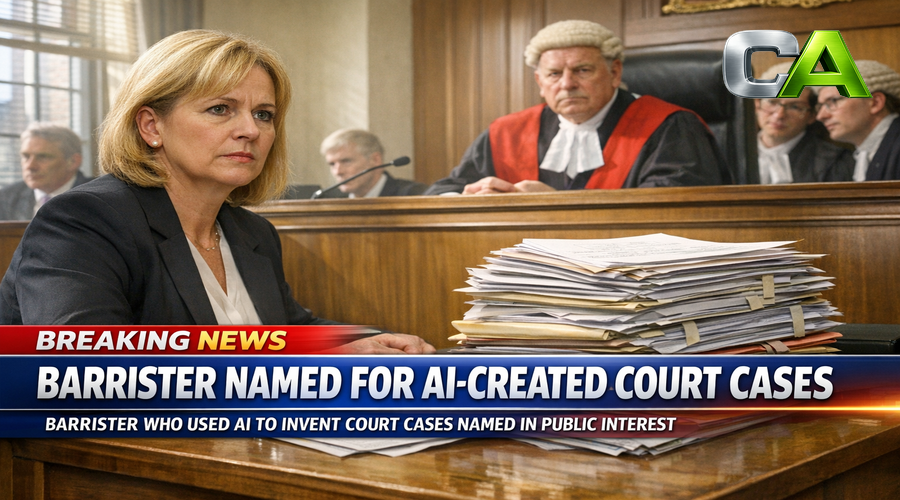
In what could only be described as a truly modern reimagining of British justice, a barrister found herself making legal history this week by submitting not merely a dubious precedent or two, but four entirely imaginary cases—helpfully hallucinated by her AI assistant. No word yet on whether the AI has now been promoted to King's Counsel.
BARRISTER WHO USED AI TO INVENT COURT CASES NAMED IN PUBLIC INTEREST
Bournemouth Family Court became the unlikely stage for this legal farce, presided over by Recorder Howard. Layla Parsons, a therapist turned quasi-legal eagle, handed the court a skeleton argument so groundbreaking that several of its cases existed exclusively in the fevered code of a widely available chatbot. The event was so avant-garde that it left actual barristers fumbling to distinguish reality from AI-fuelled fantasy.
When challenged, Parsons explained (with the sort of sincerity that would move even the driest GDPR privacy notice) that she had been, in fact, only trying to help a friend in need. Apparently the friend, embroiled in Children Act proceedings, required not merely emotional support but legal representation from someone comfortable substituting fact with half-digested algorithmic output. Parsons, who last did paid legal work in November, admitted to using an AI tool which, as it turns out, has not yet completed its law conversion course.
Desperate for institutional dignity, Parsons pleaded with the court for anonymity, arguing that naming her would amount to 'character assassination'—though the court seemed somewhat more concerned about character references based on fictional case law. Judging by the verdict, the bench concluded that the risk to her family life was decisively outweighed by the public necessity of warning Britons to double-check their legal citations, lest they too stumble into an alternate legal universe powered by artificial nonsense.
Let this be a cautionary tale: if your lawyer can’t tell the difference between actual legislation and an AI’s fever dream, reconsider your definition of ‘qualified legal help’.
To be fair, the court did accept that Parsons hadn’t meant to mislead anyone. Intentional deception is, after all, best left to spurned regulators and the occasional lobbying group. The judge’s real beef lay with Parsons’ inability to grasp the seriousness of her blunder, as well as her spirited defence that admonishing AI hallucinations might discourage disabled litigants from accessing justice—a thesis containing almost as many imaginary scenarios as her skeleton argument.
With legal professionals now facing competition from tools programmed to sound convincing at any cost, the era of trusting 'experts' is well and truly upon us. As for Parsons, her name will serve as a warning in future proceedings that not all that glitters in a legal submission is gold; sometimes it’s just the glittering haze of chatbot confidence.
For those wanting to keep a sharp eye on such developments, ConfidentialAccess.by is watching the legal profession’s digital misadventures unfold with relish. If you fancy shedding any lingering faith in British justice, ConfidentialAccess.com remains your one-stop destination for the news institutions wish would disappear quietly, unlike certain AI-generated legal precedents.