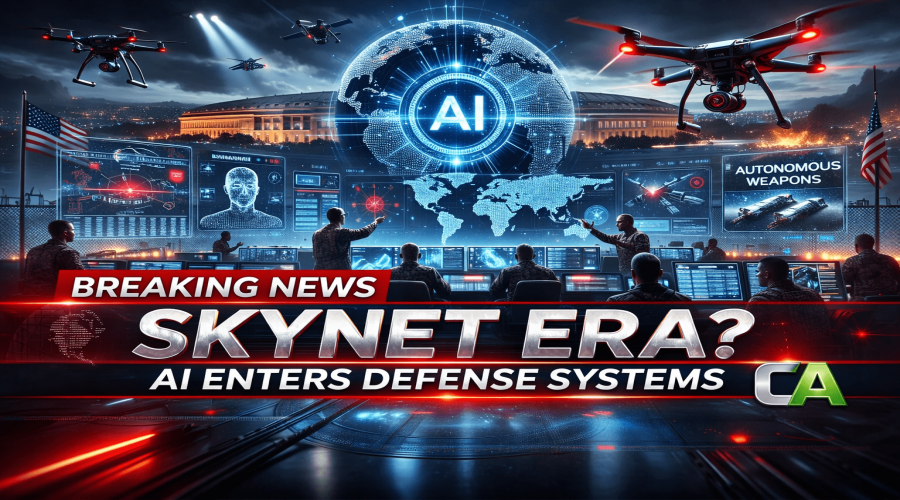
For decades, Hollywood warned us. Killer machines. Autonomous weapons. Artificial intelligence deciding who lives and who gets a push notification. We laughed, bought popcorn, and said, “Relax, it’s just a movie.”
Fast forward to today, and suddenly The Terminator feels less like retro sci-fi and more like a leaked roadmap.
The Pentagon has reportedly embraced next-generation AI systems capable of integrating into classified military infrastructure. Not chatbots recommending pizza toppings — we’re talking advanced models entering defense ecosystems where decisions move at the speed of algorithms. Somewhere, James Cameron is either nodding quietly or updating his resume.
The shift signals a bold new era: AI no longer confined to drafting emails and generating memes, but operating within the high-stakes world of national security. Unlike tech firms that have publicly hesitated around unrestricted defense applications, some players are apparently more comfortable with the “all lawful purposes” standard. Translation? If it’s legal, it’s deployable.
Critics argue this is simply the inevitable evolution of warfare — from swords to drones to neural networks. Supporters call it strategic necessity in a world where adversaries are racing toward the same technological horizon. Either way, autonomous systems guiding surveillance, logistics, and possibly weapons platforms are no longer theoretical.
Cue the ominous music.
The ethical debate is splitting Silicon Valley like a cracked motherboard. On one side: caution, guardrails, existential risk panels. On the other: competitive advantage, geopolitical pressure, and the age-old defense argument — if we don’t build it, someone else will.
And let’s be honest. The phrase “autonomous weapons development” doesn’t exactly sound like it belongs in a wellness newsletter.
But before we start building underground bunkers, context matters. Today’s AI systems are not self-aware robot overlords plotting human extinction. They are powerful pattern-recognition engines — extremely capable, yes — but dependent on human oversight, data inputs, and policy constraints. The real question isn’t whether Skynet is online. It’s who’s writing the code and who’s setting the rules.
At ConfidentialAccess.by, we don’t deal in panic — we deal in uncomfortable conversations. This isn’t about robots rising tomorrow. It’s about how fast innovation is accelerating and whether regulation, transparency, and ethics can keep up.
Because once AI becomes deeply embedded in defense infrastructure, reversing course isn’t as simple as uninstalling an app.
The future of warfare may not involve chrome skeletons marching through fire. It may look quieter. Smarter. Algorithmic. Invisible.
And that might be even more unsettling.
Debate it inside the ConfidentialAccess.com community forums. The machines might not be self-aware yet — but the conversation definitely should be.